
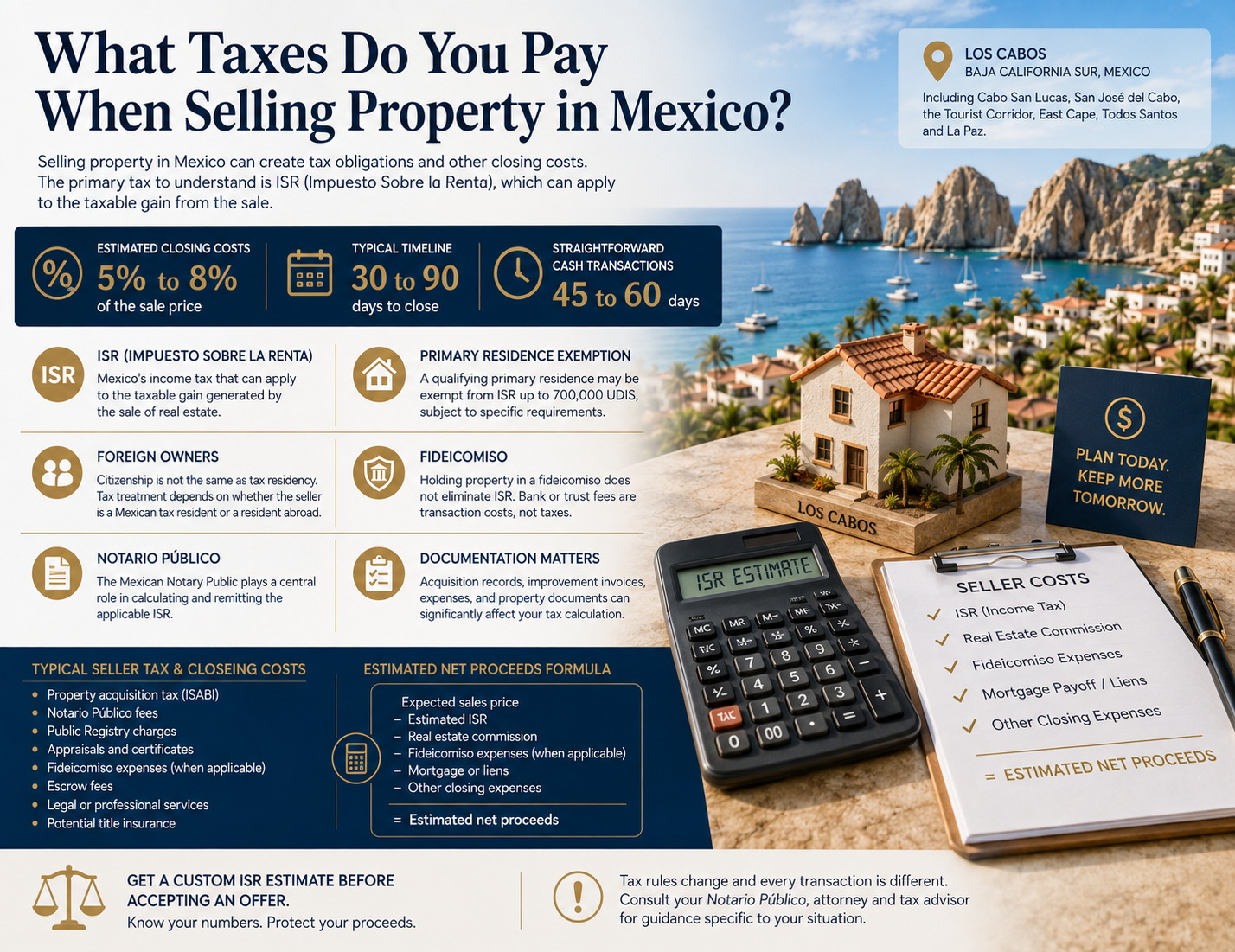
What Taxes Do You Pay When Selling Property in Mexico?
Quick Answer
This guide outlines the pricing, presentation, tax, negotiation and closing considerations sellers should evaluate for property in La Paz, Baja California Sur. Explore La Paz real estate.
Article Menu — Explore This Guide
What Taxes Do You Pay When Selling Property in Mexico?
Selling a house, condominium, villa, commercial property or land in Mexico can create tax obligations and other seller closing costs.
The primary Mexican income tax sellers need to understand is ISR (Impuesto Sobre la Renta), which can apply to the taxable gain generated by the sale.
There is no single capital gains tax rate that applies to every property seller in Mexico. The applicable calculation can depend on the seller’s tax status, documented acquisition cost, ownership history, qualifying improvements and expenses, property use, and potential eligibility for a primary-residence exemption.
These issues are particularly relevant in Los Cabos and Baja California Sur, including Cabo San Lucas, San José del Cabo, the Tourist Corridor, East Cape, Todos Santos and La Paz.
What Is ISR When Selling Property in Mexico?
ISR stands for Impuesto Sobre la Renta, Mexico’s income tax.
When Mexican real estate is sold, ISR can apply to the taxable gain generated by the transaction.
The applicable calculation is not simply:
Sales price − original purchase price = taxable gain
Depending on the seller and transaction, Mexican tax rules can allow certain adjustments and qualifying deductions before the taxable gain is determined.
Because the calculation can depend on the property’s history and the seller’s circumstances, an individualized estimate should be prepared before closing.
How Is ISR Calculated When Selling Mexican Real Estate?
When a real estate sale is formalized through a public deed, the Mexican Notary Public plays a central role in calculating and remitting the applicable ISR.
Relevant information can include:
- Documented acquisition cost
- Qualifying construction
- Qualifying improvements
- Certain notarial expenses
- Appraisal costs
- Qualifying real estate commissions
- Ownership history
- Seller’s tax status
- Property use
The exact treatment of each item should be confirmed for the individual transaction.
This is why sellers should request an ISR estimate before accepting an offer whenever possible.
Is There a Capital Gains Tax Exemption for a Primary Residence?
Potentially.
Mexican tax law provides a potential exemption for the sale of a taxpayer’s qualifying primary residence, subject to specific requirements.
The exemption can apply up to a limit expressed as 700,000 UDIS, together with additional eligibility conditions.
However, sellers should not assume that simply owning or living in a property automatically establishes eligibility.
The documentation and individual circumstances should be reviewed with the Notario Público handling the closing.
Can I avoid ISR when selling my primary residence in Mexico?
A qualifying primary residence may be eligible for an ISR exemption, subject to applicable requirements and limits. Living in or owning the property does not by itself guarantee eligibility.
Do Foreign Property Owners Pay Different Taxes?
Citizenship and tax residency are not the same thing.
Being an American, Canadian or other foreign citizen does not by itself determine how Mexican ISR will be calculated.
An important issue is whether the seller is treated as:
- A Mexican tax resident
- A resident abroad
under the rules applicable to the transaction.
Residents abroad can be subject to specific tax provisions and alternative calculation mechanisms under qualifying circumstances.
Foreign sellers should therefore avoid relying on a simple “foreigner tax rate” and instead obtain a transaction-specific calculation.
Does a Fideicomiso Eliminate Capital Gains Tax?
No.
Holding Mexican coastal real estate through a bank trust, or fideicomiso, does not automatically eliminate ISR when the property is sold.
This is particularly relevant in Baja California Sur, where fideicomisos are commonly used by foreign owners of residential property within Mexico’s constitutionally restricted zone.
A sale may also involve:
- Trustee processing
- Assignment
- Cancellation
- Bank-related charges
These transaction costs should not automatically be confused with taxes.
The seller should request a breakdown distinguishing taxes from trust and other closing expenses.
Is IVA Charged When Selling Residential Property?
Land and qualifying construction intended or used as a residential home can receive exempt treatment under Mexican VAT rules, subject to applicable legal requirements.
Commercial, hotel, mixed-use and other transactions may require a different analysis.
For this reason, sellers of commercial or mixed-use property should not assume that the tax treatment applicable to a residential home applies to their transaction.
What Documents Should Sellers Prepare?
Good documentation can materially affect the closing process and tax calculation.
Before listing a property, sellers should consider organizing:
- Original deed
- Fideicomiso documentation, when applicable
- Acquisition records
- Tax documentation
- Qualifying improvement invoices
- Property tax records
- Condominium statements
- Mortgage information
- Documents potentially supporting primary-residence status
- Other records related to qualifying acquisition or improvement costs
Missing documentation can make it more difficult to establish the property’s history and applicable costs.
When Should Sellers Request an ISR Estimate?
Ideally, before accepting an offer.
An early ISR estimate can be especially valuable when:
- The property has appreciated substantially
- The property has been owned for many years
- The property was inherited
- There are multiple owners
- The property is held through a fideicomiso
- The seller is a non-resident
- Acquisition records are incomplete
- Improvement records are incomplete
Understanding the estimated tax liability before accepting an offer allows the seller to evaluate the transaction based on expected net proceeds.
What Are the Other Costs of Selling Property in Mexico?
ISR is not necessarily the only expense associated with selling Mexican real estate.
Depending on the property and transaction, sellers may also encounter:
- Real estate commission
- Fideicomiso expenses
- Mortgage payoff
- Liens
- Other closing expenses
- Applicable professional fees
These should be separated from the actual tax calculation.
For example:
ISR = tax
while:
Real estate commission = transaction expense
and:
Fideicomiso cancellation or trustee charge = bank/trust-related transaction expense
The exact costs depend on the property and transaction.
How Much Will I Net From Selling My Property?
The amount a seller actually receives after closing can be substantially different from the property’s sale price.
A useful preliminary framework is:
Expected sales price
− Estimated ISR
− Real estate commission
− Fideicomiso expenses, when applicable
− Mortgage or liens
− Other closing expenses
= Estimated net proceeds
This calculation can help sellers determine whether an offer meets their actual financial objective.
Why an Early Tax Estimate Matters
A seller who knows the expected net proceeds before accepting an offer is in a stronger position to evaluate:
- Asking price
- Negotiated price
- Commission structure
- Expected closing costs
- Timing
- Whether the sale meets the seller’s financial objectives
This can be particularly important for long-held properties where the difference between the original acquisition cost and current market value may be significant.
Selling Property in Los Cabos and Baja California Sur
The same questions can arise when selling real estate in:
- Cabo San Lucas
- San José del Cabo
- The Tourist Corridor
- East Cape
- Todos Santos
- La Paz
Foreign ownership structures are particularly relevant in coastal Baja California Sur, where foreign residential ownership commonly involves fideicomisos when applicable.
The seller’s individual tax status, property history, ownership structure and documentation should be evaluated rather than assuming that the same calculation applies to every property.
Frequently Asked Questions
What taxes do you pay when selling property in Mexico?
The primary seller-side income tax to understand is ISR (Impuesto Sobre la Renta), which can apply to the taxable gain from the sale. Other transaction costs may also apply depending on the property and circumstances.
Is there a single capital gains tax rate in Mexico?
No. There is no single rate that applies identically to every property seller. The calculation can depend on the seller’s tax status, acquisition history, qualifying costs, improvements, property use and applicable exemptions.
Do foreigners pay capital gains tax when selling property in Mexico?
Foreign citizenship alone does not determine the ISR calculation. The seller’s Mexican tax status and the specific circumstances of the transaction can affect the applicable treatment.
Does a fideicomiso eliminate ISR?
No. Holding property through a fideicomiso does not automatically eliminate ISR when the property is sold.
Can a primary residence qualify for an ISR exemption?
Potentially. A qualifying primary residence may be eligible for an exemption subject to specific requirements and a limit expressed as 700,000 UDIS. Eligibility should be confirmed for the individual transaction.
Who calculates ISR when selling Mexican real estate?
When the transaction is formalized through a public deed, the Mexican Notary Public plays a central role in calculating and remitting the applicable ISR.
What documents can affect the ISR calculation?
Relevant documentation can include acquisition records, qualifying improvement invoices, certain expenses, property records and documents supporting primary-residence status.
When should I estimate ISR?
Ideally before accepting an offer. An early estimate helps sellers understand their potential net proceeds.
Is a fideicomiso fee the same as a tax?
No. Trustee, assignment or cancellation charges associated with a fideicomiso are transaction or bank-related expenses and should not automatically be treated as taxes.
Recent Posts


Selling Your Property in Los Cabos or La Paz: The CENTURY 21 Legendary Realty Seller’s Guide