Quick Answer
This guide organizes the benefits, carrying costs, market fit, rental considerations and due-diligence questions related to Developer Land in Los Cabos: How to Invest Without Being a Developer. Its geographic focus is Cabo San Lucas, Baja California Sur, and returns depend on the property, timing and operating assumptions. Explore Cabo San Lucas real estate.
Article Menu — Explore This Guide

Can You Develop Condominiums Without Being a Developer?
Yes. The investor does not need to personally design, permit, build or sell the project. The key is to acquire viable land and assemble an experienced, accountable team around a disciplined business plan.
Developer land is not simply a large vacant lot. It is land whose location, permitted use, access, utilities, topography and market demand may support a residential project such as condominiums, villas or homes. In Los Cabos, the difference between an attractive parcel and an investable development opportunity is established through verification—not assumptions.
CENTURY 21 Legendary Realty helps investors evaluate opportunities and coordinates the specialists needed to move from land selection to a market-ready project. Our role is to keep the commercial objective, market evidence and sales strategy connected to the technical work from the beginning.
What Is Developer Land?
Developer land is property considered for construction and commercialization at a scale beyond a single residence. Its value depends on what can legally, physically and profitably be built. A proper evaluation should examine title and liens, zoning, density, land-use compatibility, municipal restrictions, environmental conditions, water and utility availability, road access, site geometry, slopes, view corridors, construction logistics and the absorption capacity of the target market.
A conceptual unit count is only a starting hypothesis. It becomes a dependable project assumption only after the architect, responsible construction director, engineers, legal advisers and relevant authorities validate the design and permitting route.
Lote Anthology: A Practical Los Cabos Example
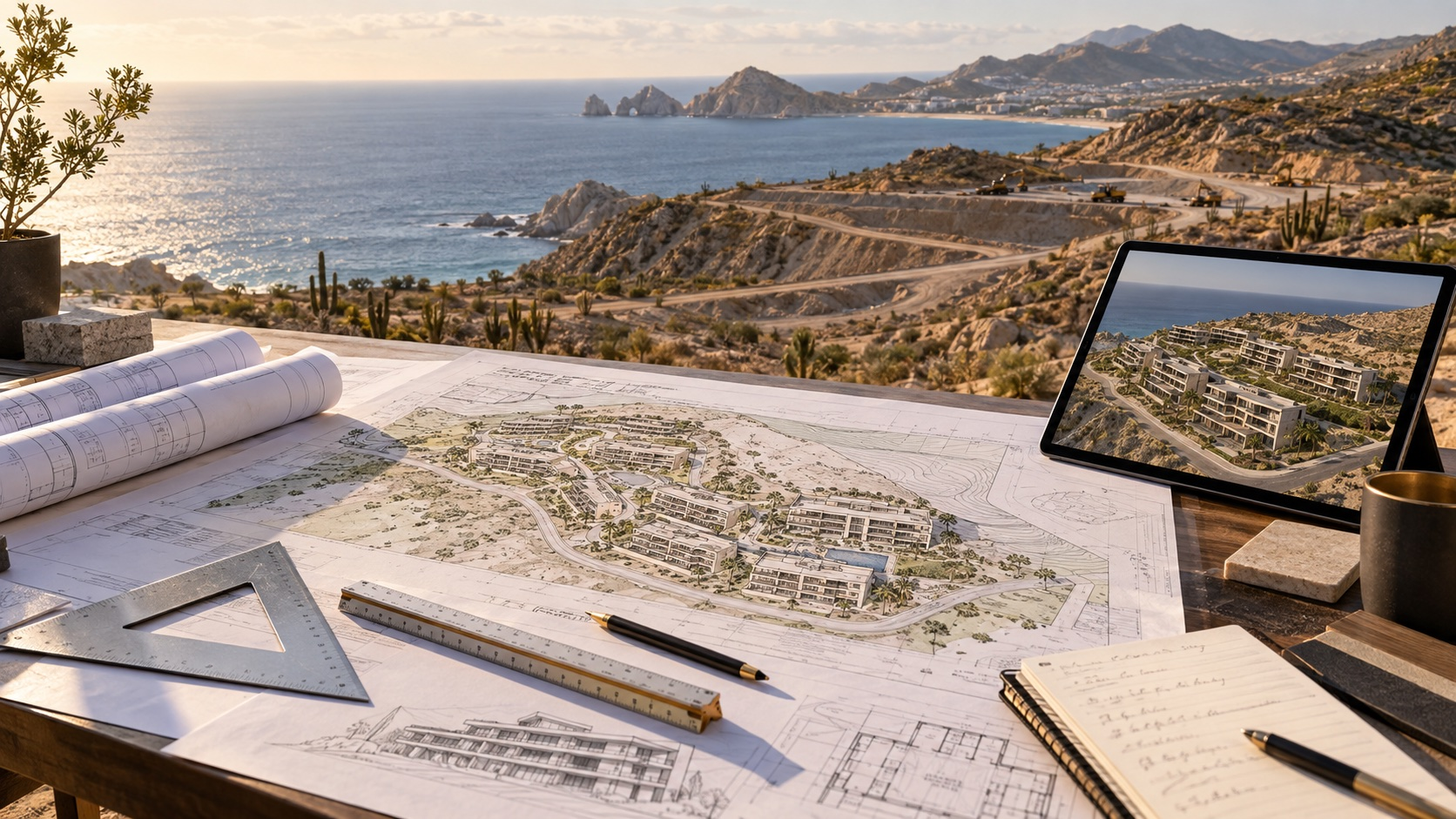
Lote Anthology illustrates the type of opportunity an investor can study. The current listing describes approximately 10,291 square meters (about 2.543 acres), RTO zoning and Pacific Ocean views in the Cabo San Lucas area. It is marketed with conceptual potential for up to 54 high-end condominiums.
Important: the potential number of units is a planning concept, not a guarantee. Density, setbacks, height, parking, access, infrastructure, environmental requirements and municipal approvals must be confirmed through formal legal and technical due diligence. Listing information, price and availability may change.
The Two Main Ways We Assist the Investor
1. Find and evaluate high-potential land
We identify land that fits the investment thesis and compare it with demand, competing inventory, achievable prices and buyer expectations. The objective is not to sell a parcel in isolation; it is to determine whether the site supports a credible real estate product.
2. Coordinate the development and sales team
We can connect the investor with an experienced developer and a construction company with more than 15 years of verifiable experience, together with architects, engineers, attorneys, notaries and other specialists required by the project.
These two functions should operate together. A technically possible project can still fail commercially, while a strong sales concept can fail if the land, permitting or budget assumptions are weak. The best decisions are made when technical feasibility, financial feasibility and market feasibility are tested before major capital is committed.
From Land Acquisition to Completed Development
- Define the investment thesis. Establish capital range, preferred location, target buyer, intended product, return objectives and holding period.
- Screen the land. Review location, access, title information, zoning indicators, utilities, topography, views and surrounding development.
- Complete legal due diligence. Qualified Mexican counsel and a notary should verify ownership, liens, boundaries, land regime, taxes, easements and the appropriate acquisition vehicle.
- Test the development concept. Architects and engineers prepare initial massing, density, parking, circulation, infrastructure and cost assumptions.
- Build the financial model. Include land, design, permits, taxes, professional fees, site preparation, construction, financing, marketing, sales commissions, contingencies and after-sales reserves.
- Confirm the permitting route. The project team identifies municipal, state and federal requirements that apply to the specific property and design.
- Structure construction controls. Use defined scopes, schedules, milestone payments, change-order procedures, quality inspections and documented responsibilities.
- Prepare the commercial launch. Position the brand, product mix, pricing, media, sales materials, lead management and closing process.
- Coordinate delivery and after-sales. Organize inspections, handovers, buyer communication and warranty claims with the responsible developer, contractor and suppliers.
Due Diligence Before Buying Development Land
A serious review should answer the following questions before acquisition or before the end of a negotiated due-diligence period:
- Is ownership clear, and are liens, restrictions or unresolved claims recorded?
- Do the legal measurements and boundaries match the physical site?
- What land use, density, height, setbacks and parking rules apply?
- Are there environmental, coastal, drainage or civil-protection constraints?
- Is legal and practical access available?
- Can water, electricity, wastewater and telecommunications serve the planned scale?
- What site work is required because of slope, geology or soil conditions?
- What permits and authorizations are necessary before construction and pre-sales?
- What comparable projects support the price, unit mix and absorption assumptions?
- Does the model include an adequate contingency for cost and schedule changes?
Los Cabos publishes municipal procedures through its services and procedures portal. Requirements vary by site and project, so investors should obtain project-specific advice rather than relying on a generic checklist.
Why Sales Strategy Must Start Before Construction
The sales team should not enter only after the building is nearly finished. Early market work can influence unit sizes, layouts, amenity priorities, finishes, price bands and release strategy. CENTURY 21 Legendary Realty can support the investor with comparative market studies, competitive analysis, buyer profiles, pricing recommendations, product positioning and a phased sales plan.
During commercialization, our advisers can coordinate marketing, lead qualification, property presentations, follow-up, reservation processes and transaction support. This creates a feedback loop: real buyer questions and objections can be reported to the development team while there is still time to improve communication or product decisions.
After-Sales Service and Warranties
Buyer confidence continues after closing. A professional delivery process should document unit condition, explain systems and common-area procedures, identify responsible contacts and maintain a clear method for reporting legitimate warranty matters.
Our after-sales role is to help coordinate communication and follow-up among the buyer, developer, contractor and relevant suppliers. Construction warranties and certifications must be issued and honored by the responsible developer, contractor or manufacturer according to the applicable agreements and regulations; CENTURY 21 Legendary Realty does not replace those responsible parties or guarantee construction work.
For residential sales in Mexico, project documents and commercial practices should be reviewed by qualified legal professionals, including any requirements that may apply under NOM-247-SE-2021.
Options for Investors Who Do Not Want to Manage Construction
Joint venture
The landowner or capital partner contributes resources while an experienced development partner manages execution under a negotiated governance and profit-sharing structure.
Development management agreement
The investor retains ownership and hires a professional manager to coordinate design, permits, procurement, construction and reporting for defined fees and responsibilities.
Entitle and reposition the land
An investor may improve the property’s readiness through studies, planning and approvals, then sell it to a builder. Feasibility and timing must still be carefully evaluated.
Phased development
A project can be divided into stages to test demand, manage infrastructure and control capital exposure, provided the master plan and permits support that approach.
Foreign Investment in Los Cabos
Los Cabos is within Mexico’s constitutionally restricted zone. Foreign buyers commonly acquire beneficial rights to coastal-area real estate through a bank trust, subject to the facts of the transaction and professional advice. The Mexican Ministry of Foreign Affairs explains the permit used to establish a real-estate trust in the restricted zone on its official guidance page. Development projects may require a different ownership or corporate structure, so investors should consult Mexican legal and tax advisers before choosing an entity.
Frequently Asked Questions
Do I need a developer license to invest in land in Los Cabos?
You do not need to personally perform every development function. The project must, however, use the qualified professionals, permits, contracts and responsible parties required for its specific scope.
Can Lote Anthology definitely support 54 condominiums?
No final unit count should be treated as guaranteed before legal, architectural, engineering and municipal verification. The listing presents up to 54 units as a conceptual development potential.
Who prepares the construction budget and permits?
The experienced developer, architect, engineers, responsible construction director and other specialists prepare the technical scope and permitting work. The investor should also use independent legal, financial and technical review.
Who sells the finished homes or condominiums?
CENTURY 21 Legendary Realty can coordinate the market study, positioning, launch, lead management, sales process and transaction follow-up, subject to a written representation agreement.
Who is responsible for construction warranties?
The responsible developer, contractor and manufacturers provide and honor applicable warranties. Our advisers help coordinate buyer communication, documentation and follow-up.
The Bottom Line
You do not have to become a builder to participate in a development opportunity. You do need disciplined due diligence, experienced execution partners and a sales strategy based on real demand. By connecting land selection, project coordination, market intelligence, sales and after-sales support, CENTURY 21 Legendary Realty helps investors approach developer land as a managed business decision.
Explore Developer Land in Los Cabos
Speak with John Ceballos about Lote Anthology or another land opportunity, and request an initial investment and market review.
This article is for general informational purposes and is not legal, tax, engineering, architectural or investment advice. Every property and project requires independent professional verification.