
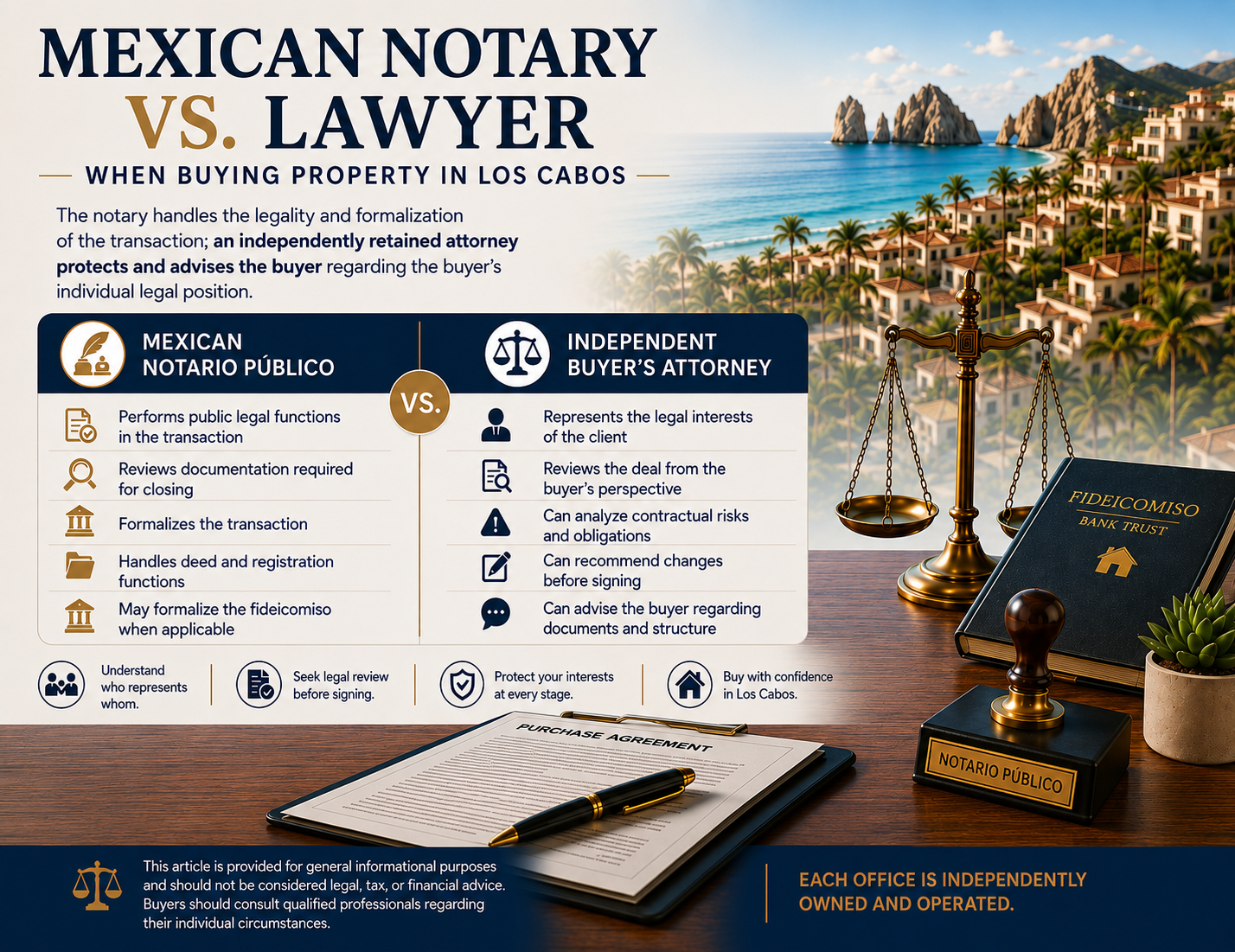
Mexican Notary vs. Lawyer When Buying Property in Los Cabos
Quick Answer
This guide explains the principal ownership, documentation, tax or closing considerations covered in Mexican Notary vs. Lawyer When Buying Property in Los Cabos. Its geographic focus is San José del Cabo, Baja California Sur. Transaction-specific details should be confirmed with the appropriate Mexican professional. Explore San José del Cabo real estate.
Article Menu — Explore This Guide
Mexican Notary vs. Lawyer When Buying Property in Los Cabos
If you are a foreign buyer considering real estate in Los Cabos, Baja California Sur, Mexico, one distinction is particularly important: a Mexican Notario Público is not automatically your personal attorney.
A Notario Público performs essential public legal functions in a Mexican real estate transaction. An independently retained buyer’s attorney, by contrast, can review the purchase specifically to protect and advise the buyer regarding their individual legal interests.
What Is a Mexican Notario Público?
A Mexican Notario Público is very different from a notary public in the United States or Canada.
In Mexico, a Notario Público is a highly qualified attorney authorized by the state government to perform specific public legal functions.
In a real estate transaction, the notary generally handles or oversees important elements such as:
- Verification of legal ownership
- Review of title documentation
- Preparation and formalization of the public deed
- Certain taxes and closing expenses
- Required certificates
- Registration with the Public Registry of Property
- Formalization of a fideicomiso when applicable
Does the Mexican Notary Represent the Buyer?
A buyer should not automatically assume that the notary is acting as the buyer’s personal attorney.
The notary generally ensures that the transaction complies with applicable Mexican legal requirements and is properly formalized.
An independently retained buyer’s attorney has a different role: reviewing the transaction from the buyer’s perspective.
That attorney may:
- Analyze contractual obligations
- Identify risks
- Recommend changes
- Explain legal consequences
- Negotiate terms before the buyer signs
Mexican Notary vs. Buyer’s Attorney
| Mexican Notario Público | Independent Buyer’s Attorney |
|---|---|
| Performs public legal functions in the transaction | Represents the legal interests of the client |
| Formalizes the transaction | Reviews the deal from the buyer’s perspective |
| Reviews documentation required for closing | Can analyze contractual risks and obligations |
| Handles deed and registration functions | Can recommend changes before signing |
| May formalize the fideicomiso when applicable | Can advise the buyer regarding documents and structure |
A useful distinction is this:
The notary handles the legality and formalization of the transaction; an independently retained attorney protects and advises the buyer regarding the buyer’s individual legal position.
Why Should a Foreign Buyer Consider an Independent Attorney?
A Mexican property purchase can involve important documents long before the transaction reaches the notary.
Depending on the transaction, these can include:
- Offer to purchase
- Reservation agreement
- Purchase or promise agreement
- Escrow agreement
- Assignment agreement
- Developer contract
- Fideicomiso instructions
- Powers of attorney
- Condominium documents
- Closing documents
Independent review can be particularly valuable when purchasing a high-value property, buying directly from a developer, acquiring pre-construction property, using seller financing, purchasing through a corporate structure, or dealing with complicated title issues.
What Can a Buyer’s Attorney Review?
Depending on the transaction, an attorney may review:
- Ownership and title
- Liens and encumbrances
- Purchase agreements
- Payment schedules
- Contingencies
- Penalties
- Closing deadlines
- Fideicomiso structure
- Developer documentation
- Condominium documents
- Final closing statement
The Timing Matters
Legal review before signing may allow a buyer to request changes.
After signing and transferring a deposit, the issue may instead become determining what contractual rights and obligations already exist.
What About a Fideicomiso in Los Cabos?
Foreign buyers purchasing residential real estate in many Mexican coastal areas commonly acquire beneficial rights through a fideicomiso, or Mexican bank trust.
Los Cabos is within Mexico’s restricted zone, making the fideicomiso relevant to many foreign-buyer transactions in the area.
A transaction may involve:
- Buyer
- Seller
- Real estate agents
- Closing coordinator
- Escrow company
- Mexican bank
- Notary
- Attorneys
Understanding who represents whom is therefore important.
Can a Buyer Rely on the Seller’s or Developer’s Lawyer?
A buyer should understand exactly who an attorney represents before relying on that attorney’s advice.
If an attorney represents the seller, developer, or another party, that attorney’s primary duty may be to that client.
This does not automatically indicate a problem with the transaction. It simply means a buyer should not assume another party’s attorney is also protecting the buyer’s interests.
When Should a Buyer Seek Legal Review?
Ideally, before signing documents that create significant financial obligations.
Seeking advice after a contract has been signed or a deposit transferred can be very different from obtaining advice beforehand.
Before signing, changes may still be possible. After signing, the legal question may instead concern the rights and obligations that already exist.
Does Hiring a Lawyer Replace the Notary?
No.
When notarization is required, the Notario Público remains an essential part of the closing process.
A buyer’s attorney and the notary perform different, potentially complementary functions.
Frequently Asked Questions
Is a Mexican Notario Público a lawyer?
Yes. A Mexican Notario Público is a licensed attorney who has received additional authorization to perform specific public legal functions.
Is the Mexican notary automatically my personal lawyer?
No. Buyers should not automatically assume the notary is acting as their independent attorney. The notary’s role in formalizing the transaction is different from independent buyer representation.
Do foreign buyers need a lawyer to buy property in Mexico?
Transactions vary. Independent legal representation can be particularly valuable for foreign buyers unfamiliar with Mexican property law, contracts, and closing procedures.
Do I need a lawyer to buy property in Los Cabos?
That depends on the circumstances of the transaction. Independent legal review may be particularly valuable before signing contracts, transferring substantial deposits, purchasing pre-construction property, or entering more complex transactions.
Does the Mexican notary verify property ownership?
Ownership and title documentation are reviewed as part of the notarial closing process together with other required certificates and documentation.
Does a fideicomiso replace a buyer’s attorney?
No. A fideicomiso is an ownership structure used in applicable foreign-buyer transactions. It does not replace independent legal advice.
Final Considerations for Foreign Buyers in Los Cabos
Buying property in Cabo San Lucas, San José del Cabo, the Tourist Corridor, or elsewhere in Los Cabos may involve legal structures and closing procedures that differ from those familiar to buyers in the United States, Canada, and other countries.
The key distinction is simple:
The Mexican Notario Público performs an essential legal and formalization role, but buyers should not automatically view the notary as their personal attorney.
Before signing, transferring funds, or closing, buyers should understand:
- What they are purchasing
- What they are signing
- Who represents their interests
- What obligations they are accepting
This article is provided for general informational purposes and should not be considered legal, tax, or financial advice. Buyers should consult qualified professionals regarding their individual circumstances.
Each Office Is Independently Owned and Operated.
Recent Posts


Selling Your Property in Los Cabos or La Paz: The CENTURY 21 Legendary Realty Seller’s Guide