
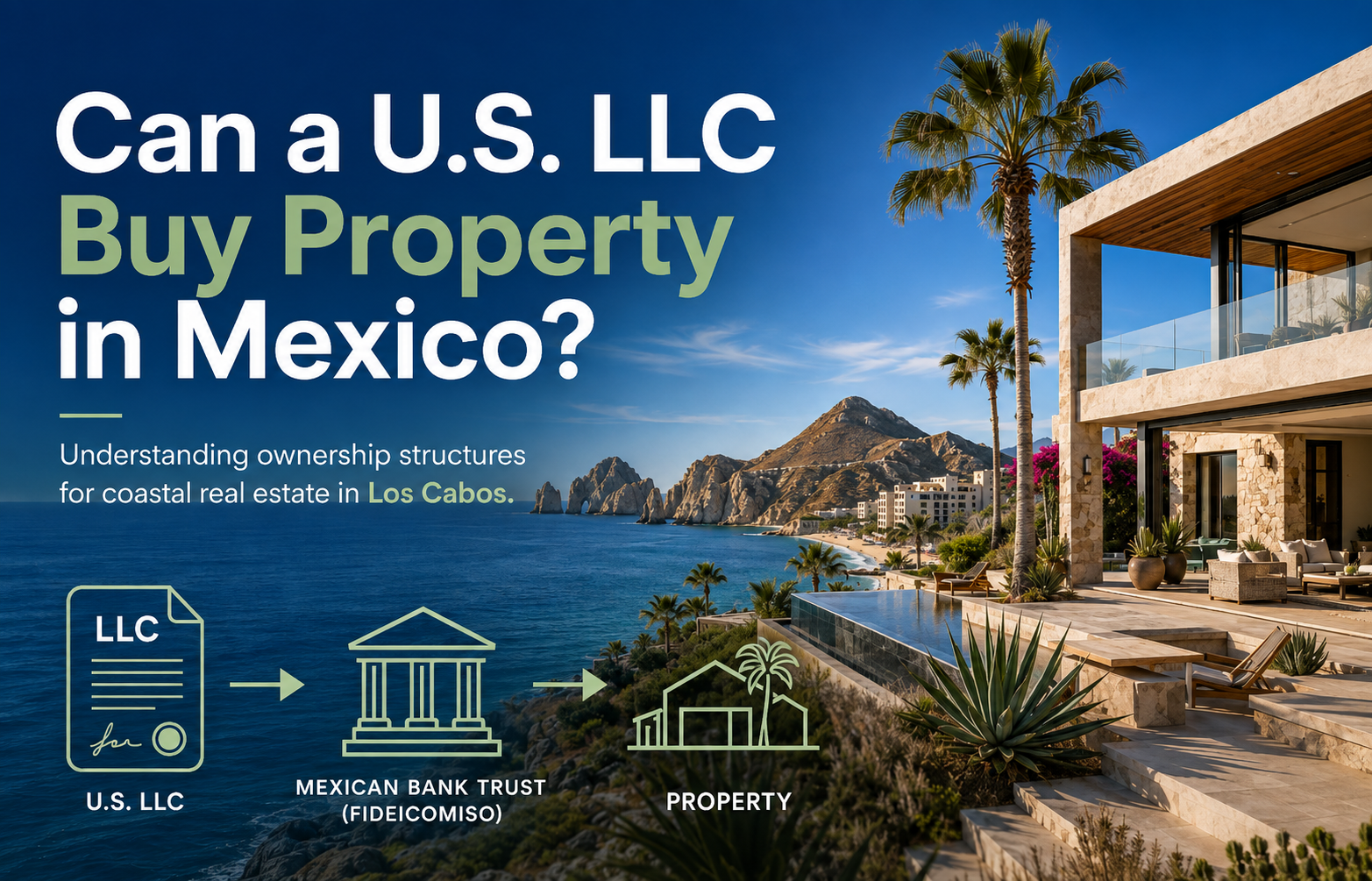
Can a U.S. LLC Buy Property in Mexico?
Quick Answer
This guide explains the principal ownership, documentation, tax or closing considerations covered in Can a U.S. LLC Buy Property in Mexico?. Its geographic focus is East Cape, Baja California Sur. Transaction-specific details should be confirmed with the appropriate Mexican professional. Explore East Cape real estate.
Article Menu — Explore This Guide
Can a U.S. LLC Buy Property in Mexico?
Yes. A U.S. LLC can generally be used as part of the ownership structure for purchasing real estate in Mexico. However, how the purchase is structured depends primarily on where the property is located and how it will be used.
For buyers considering real estate in Los Cabos, Cabo San Lucas, San José del Cabo, or other coastal areas of Baja California Sur, this distinction is particularly important because most properties in the region are located within Mexico’s restricted zone.
Can a U.S. LLC Own Property in Mexico?
Outside Mexico’s restricted zone, a foreign individual or foreign company may generally acquire Mexican real estate directly, subject to applicable Mexican legal requirements.
Inside the restricted zone, different rules apply.
Mexico’s restricted zone includes land located within 50 kilometers of the coastline and 100 kilometers of the country’s international borders.
Because Los Cabos is on the coast, a U.S. LLC generally cannot simply take direct title to residential property in the same way it might purchase real estate in the United States.
Instead, a Mexican bank trust, known as a fideicomiso, is commonly used.
Can a U.S. LLC Be the Beneficiary of a Fideicomiso?
Yes.
A foreign legal entity, including a U.S. LLC, may generally be designated as the beneficiary of a Mexican fideicomiso.
Under this structure, a Mexican bank serves as trustee and holds legal title to the property, while the LLC receives the beneficial rights to the real estate.
Depending on the terms of the trust, those rights can generally include the ability to:
- Use and occupy the property
- Lease the property
- Receive rental income
- Improve or remodel the property
- Sell the beneficial rights
- Transfer the property
- Designate successor beneficiaries
The bank does not operate the property as its own investment. Its role is to hold title and administer the trust according to its terms and Mexican law.
Fideicomisos used for foreign ownership in Mexico’s restricted zone are generally established for 50-year terms and may be renewed.
Is an LLC the Same as a Fideicomiso?
No.
A U.S. LLC is a legal entity, while a fideicomiso is the trust structure commonly used to hold rights to residential real estate in Mexico’s restricted zone.
For a residential purchase in Los Cabos, therefore, the decision is not necessarily “LLC versus fideicomiso.”
The ownership structure may involve a U.S. LLC serving as the beneficiary of a Mexican fideicomiso.
Why Would Someone Buy Mexican Property Through an LLC?
There are several reasons a foreign buyer may consider using an LLC as part of the ownership structure.
Investment Properties
An investor purchasing a property primarily for rental or investment purposes may already operate through an LLC in the United States.
Holding the beneficial interest in Mexican real estate through that entity may fit into the investor’s broader business or asset-management structure.
Multiple Owners
An LLC may also be considered when several partners or family members are investing together.
Instead of each investor individually holding part of the beneficial interest, ownership can potentially be organized through membership interests in the LLC.
Estate Planning
For some buyers, an LLC may provide additional flexibility when coordinating the property with a broader estate plan.
Mexican and U.S. estate and tax consequences should be reviewed before selecting this structure.
Business Organization
Investors who already hold multiple rental or investment properties through LLCs may prefer to incorporate their Mexican real estate into a similar organizational structure.
LLC vs. Individual Ownership Through a Fideicomiso
For many Americans purchasing a vacation home, second home, or retirement residence in Los Cabos, buying personally through a fideicomiso may be the simpler approach.
For some investors, however, using an LLC may deserve consideration.
Individual ownership through a fideicomiso may make sense for:
- A primary or secondary residence
- A retirement home
- A family vacation property
- A straightforward personal purchase
Using an LLC as part of the ownership structure may be considered for:
- Investment properties
- Properties purchased by multiple investors
- Business-related real estate strategies
- Certain estate-planning structures
- Investors who already hold assets through business entities
Neither approach is automatically better. The appropriate structure depends on the buyer’s objectives and legal and tax circumstances.
What About Creating a Mexican Corporation?
A Mexican corporation is different from a U.S. LLC.
Mexican companies with foreign investment can, under certain circumstances, acquire property directly within the restricted zone when the real estate is used for non-residential purposes.
This may be relevant for commercial projects, developments, hotels, offices, retail properties, or other business activities.
Creating a Mexican corporation solely to purchase a residential home, however, is not necessarily a substitute for a fideicomiso.
For residential real estate in coastal areas such as Los Cabos, foreign buyers and foreign companies typically use a fideicomiso.
What If I Want to Rent the Property?
Foreign buyers commonly purchase properties in Los Cabos that may also be offered as vacation or long-term rentals.
Owning the property through an LLC does not eliminate Mexican tax or regulatory obligations.
Rental income generated by Mexican real estate may create Mexican tax obligations regardless of whether the owner is an individual or an LLC.
Depending on the rental activity and ownership structure, there may also be registration, accounting, tax-reporting, VAT, income-tax, lodging-tax, or other requirements.
Buyers planning to generate rental income should therefore consult a Mexican accountant or tax professional before deciding how the property should be held.
Does an LLC Reduce Mexican Closing Costs or Taxes?
Not automatically.
Using an LLC does not eliminate the normal costs associated with purchasing real estate in Mexico.
A transaction may still involve expenses associated with:
- Notary fees
- Acquisition tax
- Public Registry fees
- Fideicomiso establishment
- Bank trust fees
- Foreign-investment permits
- Closing coordination
- Legal and due-diligence services
There may also be U.S. tax and reporting implications when a U.S. person uses an LLC to acquire foreign real estate.
Whenever possible, the ownership structure should therefore be evaluated before closing, rather than creating an entity simply because it appears more advantageous.
Can I Transfer an Existing Mexican Property to My LLC?
Potentially, but the transaction should be evaluated carefully.
Transferring an existing fideicomiso interest from an individual to an LLC may require modifications to the trust and could potentially create legal, tax, notarial, banking, or closing costs.
If you already own property in Mexico and are considering transferring your interest to an LLC, obtain professional advice before making the change.
Buying Property With a U.S. LLC in Los Cabos
For buyers purchasing property in Cabo San Lucas, San José del Cabo, the Tourist Corridor, East Cape, Pacific Corridor, or other coastal communities of Baja California Sur, the key consideration is that the property will generally be located within Mexico’s restricted zone.
A U.S. LLC can potentially be incorporated into the ownership structure, but for residential real estate the LLC would generally hold its interest through a Mexican bank fideicomiso rather than taking direct title to the property.
The appropriate structure depends on whether the property will be used as a residence, vacation home, rental investment, commercial asset, or part of a broader investment portfolio.
Before making an offer, foreign buyers should coordinate the proposed ownership structure with the appropriate professionals, including their real estate advisor, Mexican notary, closing professional, attorney, and tax advisor.
Planning the structure before closing can make the purchase and future administration of the property, as well as an eventual sale, rental operation, or transfer, considerably easier.
Frequently Asked Questions
Can a U.S. LLC buy a house in Los Cabos?
A U.S. LLC can potentially be incorporated into the ownership structure. For residential real estate within Mexico’s restricted zone, a Mexican fideicomiso is generally used, with the LLC potentially serving as beneficiary.
Does an LLC replace a fideicomiso in Mexico?
Not necessarily. For residential real estate in the restricted zone, the LLC and fideicomiso can form part of the same ownership structure.
Can an LLC receive rental income from Mexican property?
The ownership structure may allow the LLC to receive rental income, but using an LLC does not eliminate applicable Mexican tax or regulatory obligations.
Is it better to buy Mexican property personally or through an LLC?
Neither structure is universally better. The appropriate choice depends on the property’s intended use, number of owners, investment objectives, and applicable legal, tax, and estate-planning considerations.
Recent Posts


Selling Your Property in Los Cabos or La Paz: The CENTURY 21 Legendary Realty Seller’s Guide