
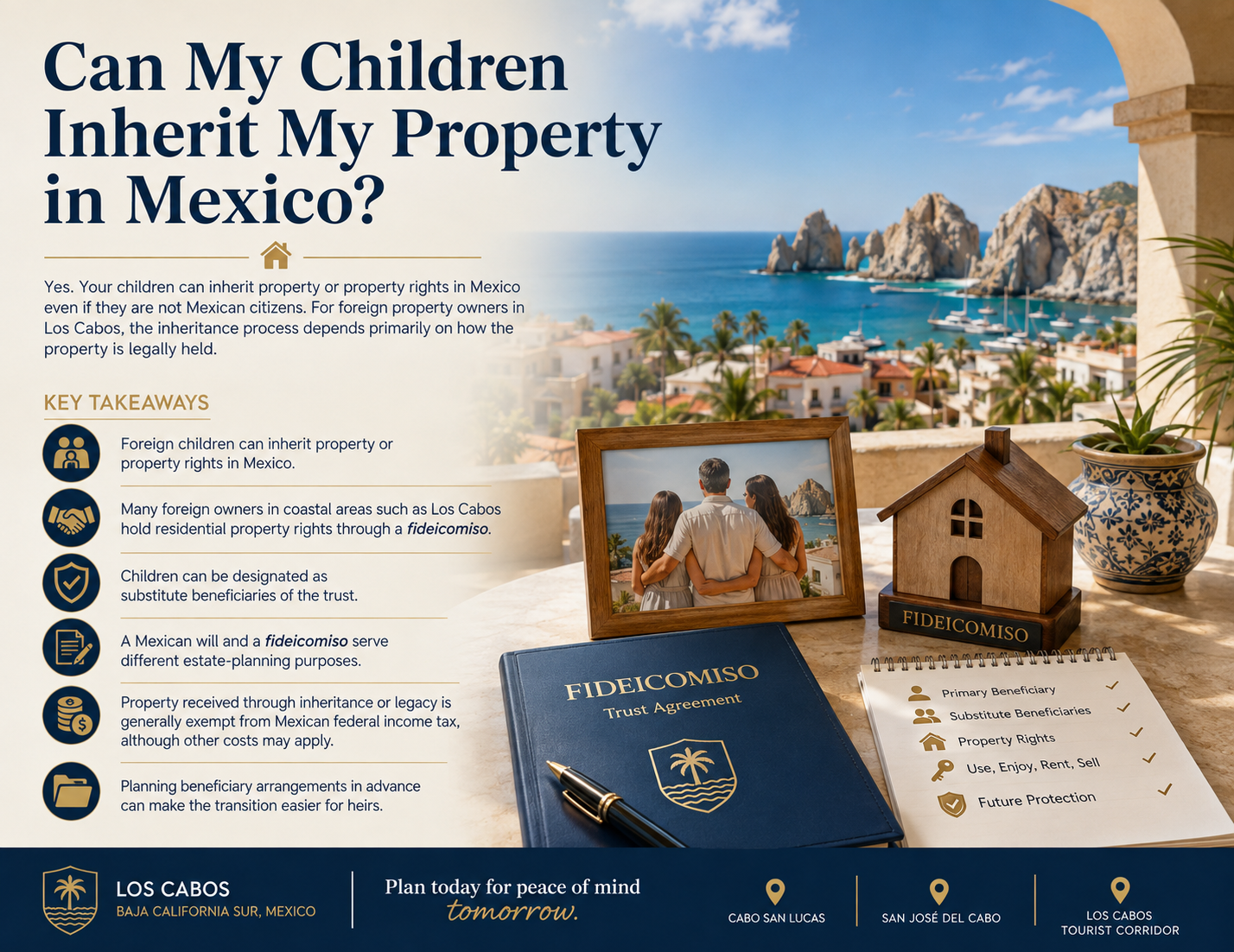
Can My Children Inherit My Property in Mexico?
Quick Answer
This guide explains the principal ownership, documentation, tax or closing considerations covered in Can My Children Inherit My Property in Mexico?. Its geographic focus is San José del Cabo, Baja California Sur. Transaction-specific details should be confirmed with the appropriate Mexican professional. Explore San José del Cabo real estate.
Article Menu — Explore This Guide
Can My Children Inherit My Property in Mexico?
Yes. Your children can inherit property or property rights in Mexico even if they are not Mexican citizens. For foreign property owners in Los Cabos, Cabo San Lucas, San José del Cabo, and other coastal areas of Baja California Sur, the inheritance process depends primarily on how the property is legally held.
For many foreign owners of residential property in Mexico’s restricted zone, that ownership structure involves a Mexican bank trust, or fideicomiso. Properly designating substitute beneficiaries can therefore be an important part of estate planning.
Key Takeaways
- Foreign children can inherit property or property rights in Mexico, subject to applicable ownership rules.
- Many foreign owners in coastal areas such as Los Cabos hold residential property rights through a fideicomiso.
- Children can be designated as substitute beneficiaries of the trust.
- A Mexican will and a fideicomiso serve different estate-planning purposes.
- Property received through inheritance or legacy is generally exempt from Mexican federal income tax, although other costs may apply.
- Planning beneficiary arrangements in advance can make the transition easier for heirs.
Can Foreigners Leave Mexican Property to Their Children?
Yes. Mexican law allows foreigners to inherit property and property rights, subject to the constitutional rules governing foreign ownership of Mexican real estate.
This is particularly relevant in Los Cabos, Baja California Sur, Mexico, because the region is located within Mexico’s restricted zone, which includes land within 50 kilometers of the coastline.
Foreign buyers acquiring residential property in this area commonly hold their rights through a Mexican bank trust known as a fideicomiso.
What Happens If My Property Is Held in a Fideicomiso?
A fideicomiso allows a foreign buyer to hold beneficial rights over residential real estate located within Mexico’s restricted zone.
A Mexican bank serves as trustee, while the foreign buyer is named as the primary beneficiary and retains the rights established under the trust to use, enjoy, rent, improve, sell, or otherwise transfer the property rights.
One of the fideicomiso’s most important estate-planning features is the ability to designate substitute beneficiaries.
Those beneficiaries can be your children.
When properly designated in the trust documents, your children may succeed to your beneficial rights after your death without requiring the property to be sold solely because of the succession.
For foreign owners of homes, condominiums, villas, or investment properties in Los Cabos, reviewing the substitute-beneficiary provisions of the fideicomiso is therefore an important part of long-term ownership planning.
Can My Children Be Beneficiaries If They Are U.S. or Canadian Citizens?
Yes.
Your children do not have to become Mexican citizens simply because they inherit beneficial rights to residential property held through a fideicomiso.
Foreign beneficiaries can generally continue holding residential property rights in Mexico’s restricted zone through the trust structure.
For example, an American owner of a condominium in Cabo San Lucas could designate their American children as substitute beneficiaries of the fideicomiso.
Should I Name My Children as Substitute Beneficiaries?
In many cases, designating substitute beneficiaries can help make the eventual transition more organized.
Depending on the owner’s estate plan and trust structure, substitute beneficiaries may include:
- One child
- Several children
- A spouse followed by the children
- Another family member
- Another person selected by the beneficiary
The appropriate structure should be reviewed with the closing attorney, Mexican notary, fiduciary bank, and estate-planning professionals involved.
Do I Also Need a Mexican Will?
A Mexican will can be an important component of estate planning for foreign property owners in Mexico.
A will and a fideicomiso serve different purposes. The fideicomiso governs the beneficial rights associated with property held within the trust, while a will can address other assets, rights, and succession matters.
Foreign owners should not automatically assume that a will executed in the United States or Canada will make a Mexican succession proceeding automatic.
Mexico may recognize certain wills executed abroad, but additional procedures may be required to establish their validity and use them in a Mexican estate proceeding.
For owners with significant assets in Mexico, professional advice can help determine whether a Mexican will should complement an existing estate plan.
What Happens If I Die Without a Will?
If a person dies without a valid will or adequate beneficiary arrangements, Mexican intestate succession rules may determine who inherits the estate.
In Baja California Sur, descendants are among the persons entitled to inherit under intestate succession rules. When only children survive the parent, the inheritance is generally divided among them in equal shares.
The process can become more complex when there is also a surviving spouse, other descendants, competing claims, incomplete documentation, or assets located in multiple countries.
Is There an Inheritance Tax in Mexico?
Under Mexico’s federal income-tax rules, property received through inheritance or legacy is generally exempt from Mexican income tax.
However, inheriting real estate does not necessarily mean the process will be free of costs.
Depending on the property and succession structure, expenses may include:
- Notary fees
- Fiduciary bank fees
- Trust amendment or beneficiary-change fees
- Appraisals
- Registration expenses
- Legal fees
- Administrative costs
- Local taxes or governmental charges that may apply
The actual costs should be determined based on the specific property and circumstances when the inheritance is processed.
What If My Children Want to Sell the Property?
Once your children have legally succeeded to the property or beneficial rights, they may generally decide whether to keep, use, rent, or sell it, subject to applicable trust, title, tax, and Mexican legal requirements.
A later sale is a separate transaction.
Receiving property through inheritance does not automatically make a future sale exempt from Mexican capital gains tax. The tax consequences should be evaluated when the property is sold.
What Documents Should Foreign Property Owners Keep Organized?
Foreign owners should maintain an organized property and estate-planning file that includes, when applicable:
- Property deed or fideicomiso
- Current beneficiary information
- Substitute-beneficiary designation
- Fiduciary bank information
- Identification documents
- Mexican tax information
- Property-tax records
- Condominium documents
- Proof of payment of trust fees
- Mexican and foreign wills
- Contact information for the fiduciary bank, attorney, and notary
Keeping these documents organized can make a significant difference for family members who may eventually need to handle the property.
Buying Property in Los Cabos With Your Family’s Future in Mind
Purchasing property in Los Cabos, Baja California Sur, involves more than selecting the right home or investment. Foreign buyers should also understand how their property rights will be held and what will happen to those rights in the future.
For foreign buyers using a fideicomiso, carefully reviewing primary and substitute beneficiaries during the closing process can help prepare for a future succession.
With an appropriate ownership and estate-planning structure, property in Cabo San Lucas, San José del Cabo, or elsewhere in Baja California Sur can pass from one generation to the next.
Frequently Asked Questions
Can my children inherit my house in Cabo?
Yes. Children can inherit property or beneficial rights to property in Cabo, including children who are foreign nationals.
Can an American inherit property in Mexico?
Yes. Americans and other foreign nationals can inherit Mexican property, subject to Mexico’s foreign-ownership rules, particularly for real estate within the restricted zone.
Can I name more than one child as a beneficiary of my fideicomiso?
Generally, yes. A fideicomiso can provide for multiple beneficiaries and substitute beneficiaries, depending on the trust structure and the requirements of the fiduciary institution.
Do my children need Mexican residency to inherit?
Mexican citizenship or residency is generally not required simply to inherit beneficial rights to residential property held through a fideicomiso.
Should I arrange the inheritance when I purchase the property?
The purchase and closing process can be a convenient time to establish and review primary and substitute beneficiaries in the fideicomiso documentation.
Can I change my beneficiaries later?
Beneficiary designations may generally be modified through the fiduciary bank and appropriate legal documentation, subject to the fideicomiso terms and applicable requirements.
Final Considerations
Yes, your children can inherit your property or property rights in Mexico.
For foreign owners in Los Cabos, coordinating the fideicomiso, substitute-beneficiary designations, and estate-planning documents can make a future succession considerably more organized.
Because family circumstances, taxation, succession rules, and trust structures vary, property owners should review their individual situation with a qualified Mexican notary, attorney, fiduciary institution, and tax professional.
Recent Posts


Selling Your Property in Los Cabos or La Paz: The CENTURY 21 Legendary Realty Seller’s Guide